Monday, March 9, 2020

AN ALABAMA EMPLOYER FAQ ON COVID-19 (CORONAVIRUS), AS OF MARCH 9, 2020.

close up shot of corona virusAlabama reported no known COVID-19 cases as of this weekend, however, it is becoming apparent that the time for preparation for a pandemic is starting to end, and the time for action items is beginning. To that end, it seems that many law firms are starting to compile answers to some frequently asked questions.

With Spring Break Plans On the Immediate Horizon, Can I Prohibit Employees from Traveling?

No. But employers can ask where the employee has traveled, and if the employee has traveled to an area designed Level 3 by the CDC, ask the employee to self-isolate upon return. This guidance, however, now has to be tempered by the fact that new cases are popping up every day in the United States and this will continue to multiply exponentially. So, while this guidance sounds good today, ask again in a week or two or three.

If I Think An Employee May Have COVID-19, What Can I Do?

You can do a few things. For example, you can ask if the employee has symptoms such as fever or a dry cough. You can also direct those employees who have virus-like symptoms or who are at high risk for infection (they live in a house where someone else has it) to go home.

If I Get a Confirmed Case of an Employee Having COVID-19, Can I Do Anything Then?

Certainly, you can tell the employee that they are not allowed to work and require the employee to provide medical documentation clearing them to work. If they can work from home, you can allow it. You can also tell other employees that they may have been exposed to COVID-19 though you should still try to keep confidential the identity of the person. Employers may also wish to inform co-workers in close contact with the sick worker that they should stay home for 14 days of self-isolation too to minimize the risk of further spread in the workplace. Ask the sick worker about all of the close contacts he or she has had so you can do contact tracing.

Can I Tell Employees to Just Stay Home if They Are Sick or Have a Fever?

Yes. The situation arises regarding whether the employee will be paid during that time, whether that time off is attributed to vacation or other paid time off. Companies are struggling with a response here; Trader Joe’s just offered more flexibility for employees in such cases. Each employer will have to find the right answer for itself. The CDC advises that you can require an employee to be fever and symptom free for 24 hours. Consider a temporary suspension on your illness policy; yes, there may be an employee who will abuse this but a generous policy can potentially stop a serious outbreak within your company.

If the Situation in the United States Worsens, Do Some Rules Change with a Pandemic?

Probably. The EEOC has advised, for example, that taking the temperature of all employees may violate the ADA under some circumstances, but has indicated that the rules may change during a pandemic such that the illness may pose a “direct threat” to others. As the EEOC has stated:

“During a pandemic, employers should rely on the latest CDC and state or local public health assessments. While the EEOC recognizes that public health recommendations may change during a crisis and differ between states, employers are expected to make their best efforts to obtain public health advice that is contemporaneous and appropriate for their location, and to make reasonable assessments of conditions in their workplace based on this information.”

As of March 8, 2020, a pandemic has not been “declared” though several states such as New York have already declared states of emergency. Employers should be cautious for now but this has the potential to change very quickly.

Can I Require Employees to Implement Infection Control Procedures, Like Mandatory Hand-Washing?

Yes. As I’ve also noted before, employers do have the obligation to provide a reasonably safe workplace. So, you should be encouraging employees to take such measures too. Here are ten songs you can encourage employees to sing too. http://bit.ly/33eTAn7

Are There Any Alabama Resources To Be Aware Of?

Yes, the Alabama Department of Public Health has launched a website here. http://bit.ly/38z5Kbq. For the latest on COVID-19, visit http://bit.ly/2vONj55. The Alabama Department of Public Health can now test for coronavirus at the state laboratory. The ADPH Bureau of Clinical Laboratories began testing for COVID-19, the illness caused by coronavirus, on March 5. Physicians have also been provided guidance for specific testing criteria. To contact the ADPH http://bit.ly/2xj9y3q. Every indication is that the COVID-19 outbreak will get considerably worse before it gets better. One need only look to Italy for such an example. Employers need to be ready now to act.

If you find this information helpful, please feel free to share.

(NOTE: A special thanks to Daniel Schwartz with the Connecticut Employment Law Blog.)


Bernard D. Nomberg has been a lawyer for more than 20 years. Bernard has earned an AV rating from Martindale-Hubbell’s peer-review rating. In 2019, Bernard was named a Super Lawyer for the 7th year in a row.


from The Nomberg Law Firm – Birmingham Workers' Compensation & Personal Injury Lawyers https://www.nomberglaw.com/blog/an-alabama-employer-faq-on-covid-19-coronavirus/

CORONAVIRUS AND THE WORKPLACE

[1]
Everyone’s eyes seem to be glued to the news lately for updates and alerts on what is happening with the Coronavirus now. Yet what do we really know about it and what can we do to make sure we never experience it up close and personal?

Now called COVID-19, the Coronavirus was first diagnosed in Wuhan, China in December. This odd name actually derives from the word corona meaning “crown,” and is based on the appearance of the spikes on the virus’s surface. The common type of coronavirus causes only mild to moderate upper respiratory symptoms, like a common cold, while a more severe type causes pneumonia and death. While this virus is commonly found in animals, some forms can mutate and transfer to people, as was the case with most of the original cases in China when specialists traced the virus back to an animal market in Wuhan, China. Mutating and transferring viruses sound like the stuff of movies, but the important piece of information to glean is how the virus is transmitted. Close contact with an infected person when fluids of the respiratory tracts are shared is the general idea health officials know, but specifics have yet to be discovered.[2]

Since this implicates the workplace, many workers are wondering what this will mean for workers’ compensation claims. If an employee is diagnosed with the Coronavirus, is this a compensable injury? In New Jersey, there is a public safety official presumption, not shared by Alabama, which means that an employee who shows hazards of their work environment caused the disease to be transmitted to them will shift the burden of proof to their employer to prove the employee’s work environment was not the reason the disease was contracted. While both are difficult outcomes to prove, the presumption strongly favors the employee being compensated.[3] Regardless of the state’s stance on compensation, employees have a right to a safe work environment, and many companies may soon develop growing flexibility and generosity when it comes to sick days and leave policies.[4]  Until then, the best plan of action for every employee is to take their health into their own hands.

As a first point of preparation, the key is not to panic. Being prepared doesn’t mean building a bunker and becoming a mole person until the CDC deems the coast to be clear. The best place to start is ensuring your home has the essentials you need should your area potentially be infected. Experts say the reason to stock up on necessities it to practice what is called “social distancing.” The fear is not that stores will run out of the items you need, but to avoid contact with potential carriers of the virus.

Talk with your insurance carrier about obtaining greater quantities of your daily medications, at least a few weeks’ supply. Doctors also recommend buying fever reducers like acetaminophen and ibuprofen ahead of time. Stock your pantry with nonperishable food and hydrating drinks like Gatorade and children’s Pedialyte. Cleaning supplies such as alcohol wipes and bleach are a vital step in prepping your home because these household cleaners are proposed by infectious disease specialists to be your best bet at ridding surfaces in your home of the virus. As far as face masks are concerned, whether these are a necessary step in preparedness is a hot topic of debate. Experts seem to agree only on the usefulness of those already sick in wearing one so as not to spread the virus to others.[5]

A final step on the road to readiness is having a plan. Make a decision in advance on what to do if childcare becomes unavailable or schools close. If you live a fair distance from elderly parents or relatives, get in touch with neighbors or friends near them who can be at the ready to provide assistance should that become imperative. Finally, talk with your employer about telecommuting as a possibility. If this isn’t feasible, make an alternative plan with your boss should the virus be found in your area. Don’t wait for an outbreak to occur before considering your readiness. Preparation today avoids panic tomorrow.

For updated information from the Centers for Disease Control and Prevention: http://bit.ly/2vONj55

If you are hurt on the job due to unsafe working conditions, seek legal counsel, as you may be entitled to workers’ compensation or other benefits. As we have since 1967, we will continue to protect the legal rights of our clients – those who are hurt on the job while working for Alabama employers.  If you have been injured on the job and want to learn your rights, please consider contacting the Nomberg Law Firm. Our office number is 205-930-6900 and website www.nomberglaw.com. Our office is located in Birmingham, Alabama. We handle cases throughout our great State.


[1] https://www.utmb.edu/covid-19.

[2] https://www.npr.org/sections/goatsandsoda/2020/01/24/798661901/wuhan-coronavirus-101-what-we-do-and-dont-know-about-a-newly-identified-disease.

[3] http://www.alabamaworkerscompblawg.com/blawg-post/a-look-at-the-potential-impact-of-the-coronavirus-on-alabama-workers-compensation-through-a-new-jers.

[4] https://www.nytimes.com/article/coronavirus-work-job.html?fbclid=IwAR1yhubKf0R-JNJxHNHidWVr0_6S1Fdf3sMffpazBjUaBQNLLEkk1BwKeyQ.

[5] https://www.npr.org/sections/goatsandsoda/2020/02/26/809650625/a-guide-how-to-prepare-your-home-for-coronavirus.


Bernard D. Nomberg has been a lawyer for more than 20 years. Bernard has earned an AV rating from Martindale-Hubbell’s peer-review rating. In 2019, Bernard was named a Super Lawyer for the 7th year in a row.


from The Nomberg Law Firm – Birmingham Workers' Compensation & Personal Injury Lawyers https://www.nomberglaw.com/blog/coronavirus-and-the-workplace/

Thursday, February 27, 2020

WHY IS EVERYONE TELLING ME I NEED A NEW DRIVER’S LICENSE?

[1]

star id alabama driver's licenseAs of late, it seems at every turn there are rumblings about Star or Real ID’s.  In October, Governor Kay Ivey stood on the steps of the Alabama Capitol giving a press conference to further impress the importance of complying with the updated policy.[2] So, this raises a few questions: What exactly is a Star ID? Why do I need it? And how can I get one?
According to the Alabama Law Enforcement Agency, a Star ID is defined as “Secure, Trusted, and Reliable, Star ID is part of a nationwide effort to improve the integrity and security of state-issued driver licenses and identification cards, which, in turn, will help fight terrorism and reduce fraud.”[3] It is Alabama’s counterpart to the federal Real ID program.

Congress passed the Real-ID Act of 2005 in response to terrorism attacks in the United States. Alabama’s development of Star ID by the Alabama Department of Public Safety is in keeping with this federal program. While there won’t be drastic changes to the overall look of the Alabama driver licenses, the Star ID will have a distinct gold star in the upper left corner to show compliance with the new standard. Once you obtain the new compliant ID, the old driver’s license will be cancelled.[4]

The importance of having a compliant Star ID is for domestic travel around the United States and gaining entrance to certain federal buildings. Beginning October 1, 2020, all travelers on domestic flights will be required to show a Star ID in order to board the plane. The only alternative to this is showing a valid passport. The same requirement is to be had for entering certain regulated federal facilities.[5]

The question now becomes: how can you get your Star ID? You can obtain your new ID before your current ID expires. They are only available at Alabama Law Enforcement Driver License examining offices, which are located statewide. Do not try to get the Star ID at the county probate office or license commissioner’s office.[6]

In order to be issued a Star ID at one of these offices, each applicant must present four documents to verify identity/date of birth, Social Security number, and address of principle residence.  If your name is different than the way it appears on any of these required documents, documentation, such as a marriage license, is required to show the reason for the change. A list of the appropriate documents can be found here.

Don’t wait until it’s too late to obtain your Star ID. The deadline to make the switch is October 1, 2020.

[1] https://www.waaytv.com/content/news/Countdown-begins-for-Alabama-STAR-ID-requirement-561929021.html.

[2] https://www.waaytv.com/content/news/Countdown-begins-for-Alabama-STAR-ID-requirement-561929021.html.

[3] https://www.alea.gov/dps/driver-license/star-id/star-id-frequently-asked-questions.

[4] https://www.alea.gov/dps/driver-license/star-id/star-id-frequently-asked-questions.

[5] https://www.alea.gov/dps/driver-license/star-id.

[6] https://www.alea.gov/dps/driver-license/star-id/star-id-frequently-asked-questions.


Bernard D. Nomberg has been a lawyer for more than 20 years. Bernard has earned an AV rating from Martindale-Hubbell’s peer-review rating. In 2019, Bernard was named a Super Lawyer for the 7th year in a row.


from The Nomberg Law Firm – Birmingham Workers' Compensation & Personal Injury Lawyers https://www.nomberglaw.com/blog/why-is-everyone-telling-me-i-need-a-new-drivers-license/

Friday, February 14, 2020

WHAT IS WORKPLACE RETALIATION?

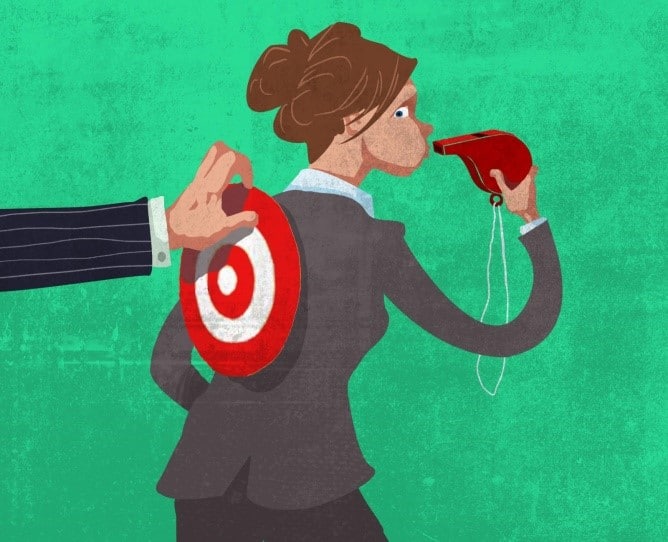
illustration of a woman in the workplace blowing a whistle with a target on her back[1]

Most people are aware of lawsuits for wrongful termination from employment, that a person who believes he or she was fired for a “bad” reason can seek action against that employer. Many people also know that the law protects employees from discrimination and harassment. But the crucial point many employees miss is the nuance of retaliatory actions against employees, not just for filing complaints about discrimination or harassment but also for filing reports of unsafe work environments.

Retaliation occurs when an employer acts in response to an employee engaging in a legally protected activity. Examples of these legally protected activities are filing a complaint with human resources about sexual harassment and reporting hazardous conditions in the workplace to the Occupational Safety and Health Administration (OSHA). Please see our recent article about “How to Report an Alabama Company for Unsafe working Conditions.” Whether you complain to an internal, state, or federal source, your complaint is not grounds for adverse treatment. Retaliation can include any negative treatment or action on the job, not matter how subtle, but the circumstances of the situation must be considered. The Equal Employment Opportunity Commission (EEOC) gives several examples that, depending on the facts of the specific case, are considered retaliation by an employer:

  • Giving a lower score or rating on a performance evaluation than is earned
  • Transferring an employee to an undesirable/less desirable position or location
  • Physical or verbal abuse
  • Threatened or filed reports against an employee such as police reports or immigration status
  • Changes in employee work schedule (for example: to conflict with family responsibilities that employer is aware of)[2]

If the actions an employer takes against you, as the employee, would deter a reasonable person in the situation from making a complaint in the future, it constitutes illegal retaliation.[3]

The first thing to be aware of when considering pursuing legal action against retaliation is time. OSHA administers more than twenty whistleblower statutes.  These are statutes that protect an employee who files a complaint about an employer’s failure to comply with safety and health standards. Each of these statutes varies in the amount of time an employee has to file a complaint of retaliation, which range from 30 days to 180 days. Within this time frame, you can file with OSHA online; through fax, email, or mail; telephone; or in-person at one of the local OSHA regional offices. When filing a complaint, though not required, it is helpful to have on-hand some documentation of the retaliation. Such documents could include copies of termination letters, copies of pay stubs, documentation of original complaint that gave rise to the adverse treatment, and copies of disciplinary actions. OSHA will then conduct interviews of each complainant to determine the need for further investigation. A determination is then made regarding the remedy that will restore you, the employee, back to the status you maintained before the adverse retaliation.[4]

While the best place to start when faced with retaliation is your immediate supervisor or human resources representative, consider contacting an experienced employment lawyer who knows your rights and will ensure you are given fair treatment.

If you are hurt on the job due to unsafe working conditions, seek legal counsel, as you may be entitled to workers’ compensation or other benefits. As we have since 1967, we will continue to protect the legal rights of our clients – those who are hurt on the job while working for Alabama employers.  If you have been injured on the job and want to learn your rights, please consider contacting the Nomberg Law Firm. Our office number is 205-255-1270 and website www.nomberglaw.com. Our office is located in Birmingham, Alabama. We handle cases throughout our great State.


David Nomberg is the Chair of the Board of Directors for Heart Gallery Alabama and Chairs the Trustee Board for Zeta Beta Tau Fraternity at the University of Alabama.


[1] http://www.radicalcompliance.com/2019/02/27/podcast-ccos-facing-retaliation/.

[2] https://www.eeoc.gov/laws/types/retaliation.cfm.

[3] https://www.nolo.com/legal-encyclopedia/workplace-retaliation-employee-rights-30217.html.

[4] https://www.whistleblowers.gov/complaint_page.


from The Nomberg Law Firm – Birmingham Workers' Compensation & Personal Injury Lawyers https://www.nomberglaw.com/blog/what-is-workplace-retaliation/

Wednesday, January 22, 2020

HOW TO REPORT AN ALABAMA COMPANY FOR UNSAFE WORKING CONDITIONS

photo of an injured worker with yellow hard hatIt is the objective of the Occupational Safety and Health Administration (commonly known as OSHA) to ensure that working conditions across the country are safe, but not every warehouse and factory is full of OSHA investigators to double check that every guideline is met with compliance. In a shocking statistic, OSHA reported that 5,250 workers died on the job in 2018. That is the equivalent of over 100 deaths a week, or 14 deaths happening every day. Of these deaths, 1 in every 5 occurred in the field of construction.[1] These numbers are the horrifying truth. Whether the cause of these tragedies is freak accident or a company compromising in the name of maximized profits, not every ‘i’ can be dotted and ‘t’ crossed.

Thankfully, OSHA provides a safe and anonymous way to report your company should you find the conditions of your employment result in situations that jeopardize your safety or the safety of your co-workers. Employees have the option of filing an online complaint form that will be reviewed by an OSHA employee. Just be sure to check the box asking that your name be withheld from your employing company if you wish to remain anonymous.

As a first step when met with conditions that are not immediately life-threatening, an employee should attempt to first bring the hazardous conditions to the attention of his immediate supervisor. If a situation or working condition is so severe as to make you fear for your imminent safety, and there is not sufficient time to warn your superiors, you have the legal right to refuse to work or perform tasks associated with the unsafe condition. [2] Whichever route you choose to report the safety conditions at your job, the goal is to always bring the conditions back into keeping with OSHA guidelines and prevent injury to yourself or others.

Here are a few examples of what to look out for on the job to avoid injury:

  • Lack of appropriate safety equipment
  • Missing safety guards on machinery
  • Lack of/insufficient employee training
  • Malfunctioning equipment
  • Unaddressed maintenance issues
  • Blocked, wet, and slippery walkways
  • Blocked safety exits[3]

It is understandably a serious concern that reporting negligently maintained working conditions could result in retaliation from an employer. However, OSHA accepts reports of incidences of such behavior within one month of the incident, as this is against federal and state law. Retaliation includes acts such as demotion, firing, disciplinary action, denying benefits, and other forms of punishment.[4] These incidences can be filed online here. As Alabama follows the federal OSHA plan, all complaints of retaliation may be made directly to OSHA.

Alabama has two OSHA offices:


Birmingham area office Mobile area office
Medical Forum Building 1141 Montlimar Drive,
950 22nd Street North, Suite 1006,
Room 1050
Mobile, AL 36609 Birmingham, AL 35203
(251) 441-6131 (205) 731-1534

If you are hurt on the job due to unsafe working conditions, seek legal counsel, as you may be entitled to workers’ compensation benefits.

As we have since 1967, we will continue to protect the legal rights of our clients – those who are hurt on the job while working for Alabama employers.  If you have been injured on the job and want to learn your rights, please consider contacting the Nomberg Law Firm. Our office number is 205-255-1270 and website www.nomberglaw.com. Our office is located in Birmingham, Alabama. We handle cases throughout our great State.


[1] https://www.osha.gov/data/commonstats.

[2] https://www.osha.gov/workers/.

[3] https://www.gerberholderlaw.com/atlanta-workers-compensation/report-unsafe-working-conditions/?fbclid=IwAR2q7Yv9BtmPrFU7DFJ0fLBCaOYZZIVtkCVWtDexOagrJyA2oEqdcccUD4c.

[4] https://www.oshaeducationcenter.com/articles/reporting-labor-violations/.


Bernard D. Nomberg has been a lawyer for more than 20 years. Bernard has earned an AV rating from Martindale-Hubbell’s peer-review rating. In 2019, Bernard was named a Super Lawyer for the 7th year in a row.


from The Nomberg Law Firm – Birmingham Workers' Compensation & Personal Injury Lawyers https://www.nomberglaw.com/blog/how-to-report-an-alabama-company-for-unsafe-working-conditions/

Tuesday, January 7, 2020

THE ALABAMA WORK COMP ACT GETS YOU COMING AND GOING

alabama's coming and going doctrineFrom an outsider’s perspective, the road from a workplace injury to compensation provided by an employer seems black and white. If someone gets hurt at work, they should be paid work comp benefits. Right? In reality, this path involves more hurdles and takes unexpected turns.

Just because an injury occurs in the workplace doesn’t always mean an employee

 will be awarded workers’ compensation for that injury.

In Alabama, to be compensable an employee’s injury must have a causal relationship to the working conditions of the employee’s job performance.[1] This means that in order for an employee to recover, it must be shown that an occupational hazard is what caused the employee’s injury. It must also be shown that the conditions of an employee’s workplace put the worker at greater risk of injury (i.e., driving a forklift in a warehouse or climbing trees for forestry removal) compared to circumstances existing outside of the employment (i.e., mowing the grass at home or shopping at the mall). In either instance, a purely personal cause of an injury is not a recoverable basis under this rule.

At first glance, this requirement seems to set a low bar for recoverable injuries. In application, however, this doctrine bars many claims. One example of this is based on the aptly named “coming and going rule.” Under this rule, an injury occurring while an employee is traveling to or from work does not result in a compensable claim for workers’ compensation.[2] Therefore, even though the worker may be traveling to his job to perform the duties set out by his employment, his actions do not yet fall under the protective umbrella of recovery.

Even with the daunting reality sinking in that being injured at work does not always equal compensation for growing medical costs, there are exceptions to this doctrine that carve out comfort. Such exceptions include instances where the employer pays the injured employee’s travel expenses, when the injury is sustained on the employer’s property, and when an employee  crosses a public street from a parking lot owned by his employer.[3] The application of an exception to the coming and going rule is determined on a case by case basis because it depends heavily on the facts surrounding the injury. In one case, the Alabama Court of Civil Appeals found that a workers’ compensation claim was not barred even though the employee was injured while driving home because the employer encouraged employees to finish daily duties at home, the injury occurred while the employee was still on the clock, and the employer allowed employees to run personal errands while technically on the job.[4]

Even though the coming and going rule has exceptions, these exceptions are not universally applied. It is not guaranteed that every instance of an employee crossing a street when leaving company property will result in compensation. Nor is it a certainty that an employee receiving a traveling stipend is grounds for employer liability. One example of a case that appeared on its face to meet an exception yet did not in application is one involving an injury in the company parking lot. A nursing student, who worked for the hospital owning the parking lot as a patient care assistant, fell in the parking lot while attending a class at the hospital. She had just completed a shift at the hospital and began a class being held at the hospital when she left class to retrieve a book from her car. This is when she sustained the injury. The exception to the coming and going rule did not apply to the injured student’s case because her injury was not sustained while in her employee capacity. In the eyes of the appellate court, because the injury was sustained after the nursing student made the shift from employee to student (because she began class before going out to the parking lot), the hospital, her employer, was not on the line to pay the nursing student workers’ compensation. The court noted that for an exception to apply, and therefore compensation to be awarded, the employee needed to be injured while acting in a manner incidental or natural to the work she was hired to perform.[5]

Just because you were not at work when an injury occurred does not always leave you without a cause of action. Likewise, even though the exception to the coming and going rule is narrowly applied, this does not mean all claims are pointless. Always look to the circumstances of your injury for the potential of an exception.

Some videos related to this topic:

As we have since 1967, we will continue to protect the legal rights of our clients – those who are hurt on the job while working for Alabama employers.  If you have been injured on the job and want to learn your rights, please consider contacting the Nomberg Law Firm. Our office number is 205-930-6900 and website www.nomberglaw.com. Our office is located in Birmingham, Alabama. We handle cases throughout our great State.


[1] Ex Parte Patton, 77 So. 3d 591 (Ala. 2011).

[2] https://www.wmalabamalaw.com/employment-law-blog/2016/july/what-is-the-coming-and-going-rule-/.

[3] https://lgwmlaw.com/news-media/LIMITATIONS-ON-EXCEPTIONS-TO-THE-COMING-AND-GOING-RULE/.

[4] Hospice Family Care v. Allen, 218 So. 3d 1222 (Ala. Civ. App. 2016).

[5] McDuffie v. Medical Center Enterprise, 2012 Ala. Civ. App. LEXIS 249 (Ala. Civ. App. Sept. 14, 2012).


Bernard D. Nomberg has been a lawyer for more than 20 years. Bernard has earned an AV rating from Martindale-Hubbell’s peer-review rating. In 2019, Bernard was named a Super Lawyer for the 7th year in a row.


from The Nomberg Law Firm – Birmingham Workers' Compensation & Personal Injury Lawyers https://www.nomberglaw.com/blog/alabama-work-comp-act/

Thursday, December 19, 2019

WHOSE WILL IS IT?

illustration of two hands shakingWhen you hear the phrase “at-will” employment, it’s only natural to think one of two things: every working relationship is “at-will” because all the parties involved chose to be there, or, I don’t actually want to work at all; give me a white sand beach and that’s where my will wants to be. Regardless of what you may think of the term, or how it may apply to you and the job you have, for Alabama employees it is important to know exactly how to classify your working situation. It can make all the difference in your rights in the workplace.

You’ve probably heard this phrase thrown around the most in the context of the government lately when the news broadcasters say an official “serves at the pleasure of the president.” Well, think of yourself, the employee, as the official and your boss, the employer, as the president. An “at-will” employee is one who works, and potentially ceases to work, at the pleasure, or discretion, of the employer. An employee can be fired for any or no reason at all.

It is presumed that this kind of working relationship exists unless there is contrary evidence, such as a contract stating other parameters regarding employment. Otherwise, you can usually find statements categorizing your employment as at-will in the application you filled out to obtain the position or in your employee handbook. It is a rare occasion that an employer leaves this relationship’s classification open to interpretation. While this description also indicates that an employee can leave his position if ever he chooses for any reason he sees fit, this distinction doesn’t immediately bring the sense of stability or empowerment that an employee imagines his employer to have in this type of relationship. The state of Alabama recognizes this relationship as fair, but for you, the employee, to feel safe in a workforce based on this dynamic, it’s important to know your rights and any exceptions that can swing the pendulum back in your favor.[1]

Exceptions exist to what is referred to in the legal community as the at-will employment doctrine. Such exceptions include termination for seeking workers’ compensation benefits, retaliation, and discrimination.[2][3] In Alabama, employers cannot fire solely because an employee seeks workers’ compensation benefits – this is a protection under the Alabama Workers’ Compensation Act.  If an employee is fired because he files a claim or an employer believes an employee will file such claim, this constitutes wrongful termination under the law and an employee is protected from this act. Likewise, if an employee is fired for retaliatory reasons, an example of which would be a termination in response to complaint of sexual harassment or an employee’s refusal to commit illegal activities at the request of the employer, he is entitled to protection again because this constitutes wrongful termination. Discrimination against age, race, gender, religion, national origin, and disability is also grounds for wrongful termination. An Alabama employee is protected by federal law if fired for such a reason.

As an employee in Alabama, it is important to know your rights in an “at-will” employment relationship and to recognize that you are not always at the mercy of the whims of your employer. Seek aid if you suspect that you lost your job by means of wrongful termination.


For related articles:

As we have since 1967, we will continue to protect the legal rights of our clients – those who are hurt on the job while working for Alabama employers.  If you have been injured on the job and want to learn your rights, please consider contacting the Nomberg Law Firm. Our office number is 205-395-0532 and website www.NombergLaw.com. Our office is located in Birmingham, Alabama. We handle cases throughout our great State.


[1] Ex Parte Moulton, 116 So. 3d 1119, 1134 (Ala. 2013).

[2] Tyson Foods, Inc. v. McCollum, 881 So. 2d 976, 978 (Ala. 2003); Coca-Cola Bottling Co. Consol. v. Hollander, 885 So. 2d 125, 130 (Ala. 2003); Willmore-Cochran v. Wal-Mart Associates, Inc., 919 F. Supp. 2d 1222, 1239 (N.D. Ala. 2013).


Bernard D. Nomberg has been a lawyer for more than 20 years. Bernard has earned an AV rating from Martindale-Hubbell’s peer-review rating. In 2018, Bernard was named a Super Lawyer for the 6th year in a row and he was recognized as one of the Top 50 Lawyers in Alabama.


from The Nomberg Law Firm – Birmingham Workers' Compensation & Personal Injury Lawyers https://www.nomberglaw.com/blog/at-will-employment-state/